
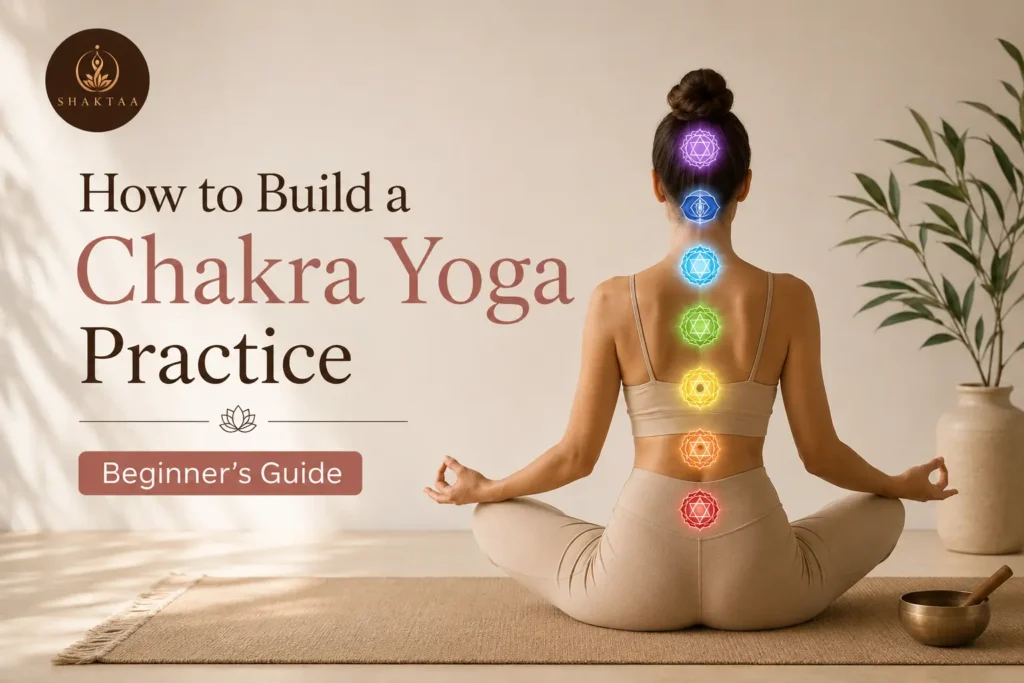
Chakra yoga practice includes yoga postures, breathing techniques, meditation and mindful awareness – all set within the framework of the seven chakras itself. Rather than being an additional style of yoga, this approach actually utilizes standard yoga methods for exploring aspects of our nature such as grounding, creativity, confidence, compassion, communication, intuition and inner awareness itself.
In yogic traditions, chakras are frequently spoken of as subtle energy points that connect to various facets of our life. For beginners, chakra balancing yoga is more about having better awareness of the body, breath and mind, and less about trying to force a certain energetic experience.
You do not need advanced flexibility or a complicated routine to begin. A simple, consistent chakra yoga practice can introduce you to the principles of working with the seven chakras while giving you space to explore the practice at your own pace.
How Chakra Balancing Yoga Works
Chakra balancing yoga uses our traditional chakra system as a goal-oriented framework for a yoga and chakras balancing practice. The physical practices remain familiar, but greater attention is given to how movement, breathing, and meditation influence your overall experience.
Yoga postures (asanas) really help build your physical awareness – they form a solid base for our practice. Moving with awareness instead of just finishing positions lets you really see your posture, breathing patterns, and bodily sensations.
Breathwork (pranayama) really narrows your focus onto the breath itself. For newbies, slow and regular breathing can make for a very natural transition from physical positions to a much calmer, almost more inwardly focused state itself.
Meditation provides space to observe thoughts, emotions, and sensations without needing to interpret or change them.Using the chakra system, our internal focus might be directed at qualities commonly linked to various chakras – like stability, self-assurance, empathy, or our inner intuition itself.
Practice doesn’t demand a set order or any specific energy experience itself. A session really just involves moving very mindfully indeed, becoming much more aware of your breath – and then finishing off with a couple of minutes’ complete stillness. What’s essential here is the real intention driving your practice – and the overall quality of your concentration on the task itself.
Working With the 7 Chakras in Yoga Practice
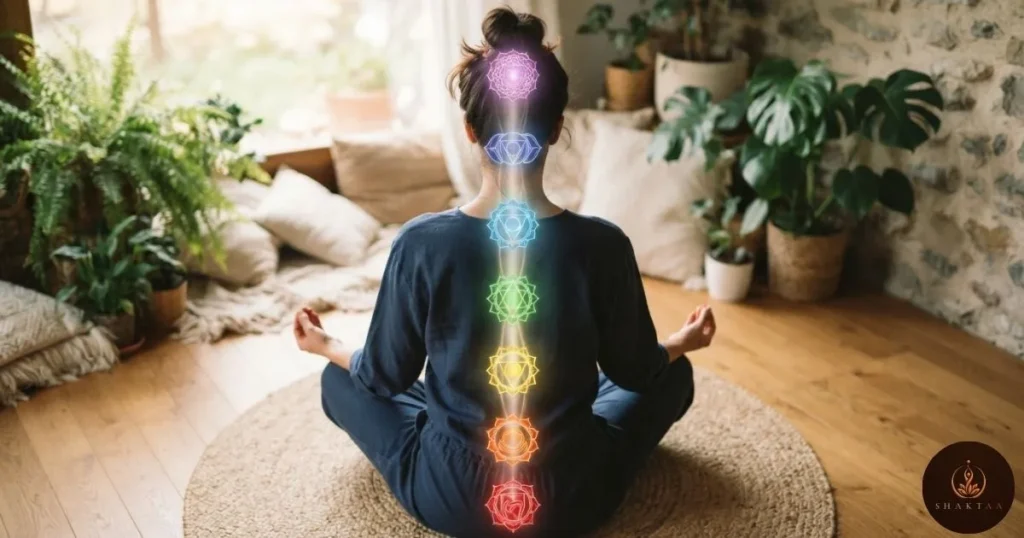
The classic seven-chakra system really offers a framework for bringing your intention into your yoga practice via movement, breathing techniques, meditation, and some deep self-reflection. This is often where 7 chakra balancing yoga becomes useful as a starting point — giving beginners a clear, traditional structure to move through, from grounding and stability all the way to stillness and inner awareness, rather than trying to explore energy work without any framework at all.
- Root chakra (Muladhara) – Stability, grounding, security itself.
- Sacral chakra (Svadhisthana) Creativity,flow – and emotional awareness all around.
- Solar plexus chakra (Manipura): your own personal power, and very deliberate action indeed.
- Heart chakra (Anahata) Compassion, feeling related and very open-hearted.
- Throat chakra (Vishuddha) Communication, expressing yourself truly.
- Third eye chakra (Ajna) Intuition and inner Knowing
- Crown chakra (Sahasrara) Meditation, being mindful – and connecting with a higher consciousness every time.
These associations actually originate from traditional yogic and tantric frameworks – though they might differ a bit across different traditions indeed.
You don’t have to use all seven chakras in each practice session. Focusing on just one aspect gives you a clear goal, whereas going through all seven really takes you on a wider journey – starting with grounding and our physical presence to quieter reflection.
How to Develop a Yoga Practice for Chakra Balancing
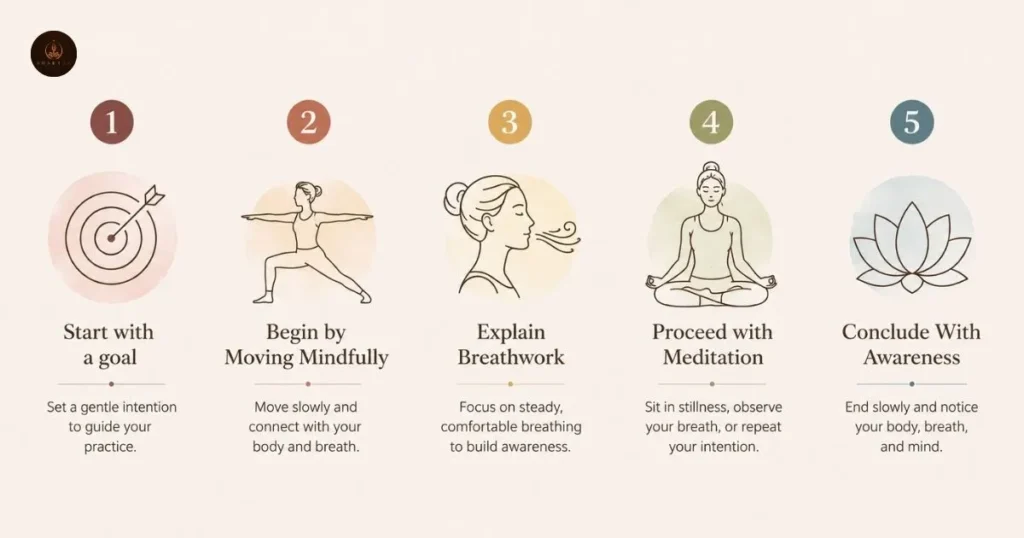
Using our chakras, an energy-balancing yoga practice doesn’t have to be lengthy or difficult. A straightforward framework is frequently simpler to follow for novices and provides ample room to transition from physical awareness to breathing and meditation.
1. Start with a goal
Take a moment to decide what you want to explore before you start your practice. Grounding, self-expression, compassion, self-assurance, or simply becoming even more present may be your objectives.
A goal is not a necessary outcome. You can use it as a gentle focal point to direct your attention during the session.
2. Begin by Moving Mindfully
Start with easy yoga poses that help you become conscious of your body and breathing. It’s not necessary to select challenging positions or strive for physical intensity.
Instead of attempting to produce a specific energetic feeling, move slowly and focus on how your body feels. This method allows awareness to grow organically while maintaining accessibility to the practice.
3. Explain Breathwork
Gradually increase your focus on your breathing whenever your body is ready. Especially when you’re new to pranayama practice, preserve a very steady and extremely comfortable breathing pattern.
The idea is to establish a connection between calmer awareness and physical movement. For a beginner’s practice, strong breathwork or extended breath retention are not required.
4. Proceed with Meditation
After your breathing exercises and physical activity, take a little time to be still. Find a quite comfortable spot – sit or lie down so you remain both alert and very relaxed indeed.
You can silently consider the chakra traits you have chosen to investigate, monitor the breath, or repeat a straightforward intention. You don’t have to look for strange feelings or a specific event.
5. Conclude With Awareness
Rather than immediately returning to your usual routine, discontinue the practice very gradually. For a little while, focus on your breathing, bodily feelings, and mental condition itself.
This straightforward change helps transform chakra balancing yoga from a set of discrete exercises into a whole practice. The sequence can grow more comfortable over time and organically adjust to your demands and free time.
One Chakra or All Seven?
You don’t need to deal with all seven chakras in every yoga session. Your strategy may rely on your aim, experience and time available.
Focusing on one chakra will offer your practice a definite focus, such as grounding, stability, compassion or connection. working with all seven chakras provides a larger practice, moving through the traditional chakra system from grounding to intuition and contemplation.
Either way is fine for beginners. There are seven chakras, it’s a traditional way to look at it, but you don’t have to activate or balance every chakra in a particular way. Even a brief regular exercise in one virtue can be of importance.
As you get more at ease with chakra balancing yoga, you really can play around with your intentions – and weave together movement, breathing techniques, and meditation in whatever way truly resonates with your practice.
How to Create a Regular Yoga Practice for Chakra Balancing
The benefit of this yoga of chakra balancing is in the regular practice, not in aiming to get any kind of experience. Pick a time frame that suits your needs best – then start off with some quiet breathing, set an intention, or make a very subtle move.
Let your practice unfold naturally. On some days, certain yoga postures may feel more suitable – while on others, breathing exercises or meditation might be the way forward. Stop attempting to experience extraordinary feelings or ‘wake up’ your chakras. Instead, concentrate on observing actual daily improvements – like becoming even more present-minded, feeling a lot more comfortable in quiet stillness, and reacting far less irrationally to our thoughts.
Chakra yoga can be a simple way to explore mindfulness, self-awareness, movement and breath with regular, patient practice.
What to Expect From Chakra Balancing Yoga
Every session of chakra balancing yoga can feel different. You might feel physical sensations from the exercise, notice changes in your breathing, feel more aware of your body, or have a quieter mind. Some sessions may feel very introspective, yet others feel rather mundane.
You don’t have to feel anything special for your practice to be worth it. You might feel warmth, tingling sensations, emotional changes, or even a lighter feeling while doing yoga or meditating – these sensations are very individualized indeed and should really not be considered the ultimate proof that you have opened or balanced a particular chakra.
Instead of expecting a spectacular energy response, notice the quality of your awareness. Are you breathing more mindfully? Can you be present in your body? Can you sit calmly, without needing regular stimulation?
This approach makes chakra balancing yoga a grounded practice of movement, breathwork and meditation while still honoring its traditional spiritual foundation. Come to each session with curiosity rather than anticipation and allow your experience to evolve without having to categorize every sensation or emotion.
Traditional Chakra System vs. Modern Understanding
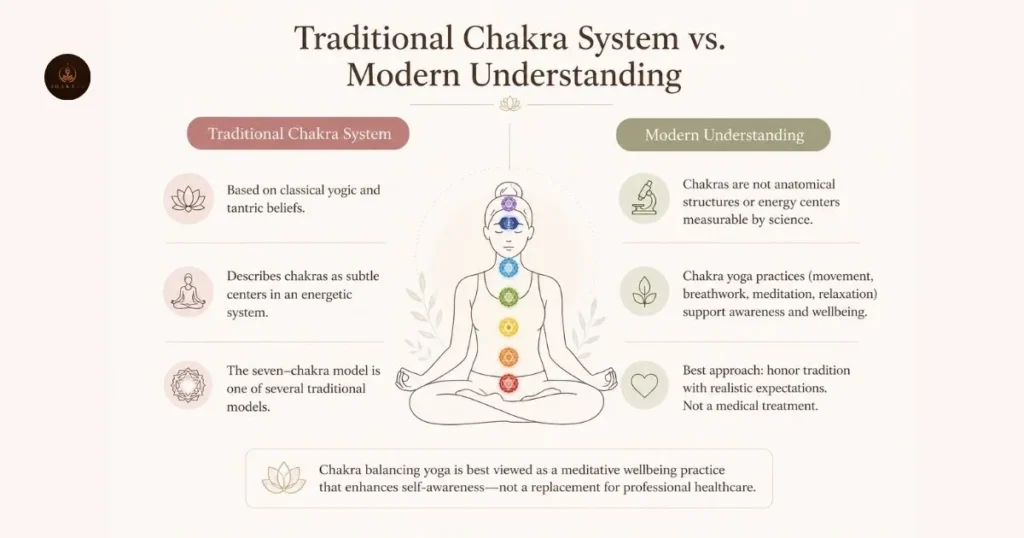
Chakras are based on classical yogic and tantric beliefs, where they are defined as subtle centers in an energetic system. Various religions describe the chakra system differently, therefore the famous model of seven chakras should be seen as one of several frequently used models, rather than a universal system.
From the standpoint of current science, chakras are not anatomical structures or energy centers that can be medically measured. When you are doing chakra balancing yoga, this distinction is significant. According to the National Center for Complementary and Integrative Health, reviews of yoga-based programs have found measurable benefits such as gradual weight reduction and improvements in pain, function, and stiffness — but these findings relate to yoga’s physical and mental effects, not to any scientifically verified energy system. The practice can be studied as a spiritual tradition or as a structure for contemplation and self-awareness without portraying chakras as scientifically proven physical structures.
Simultaneously, the practices often associated with chakra yoga, such as physical movement, aware breathing, meditation and relaxation, can be directly accessed through the feelings they generate. That increased awareness of your body, breath, attention and mental state might be meaningful without having to verify or measure a particular energetic consequence.
Beginners should take the best balanced approach by honoring the historic origins of the chakra system and maintaining reasonable expectations. Chakra balancing yoga should be thought of more as a meditative wellbeing practice than a medical treatment or substitute for professional health care.
Common Mistakes Beginners Make in Chakra Balancing Yoga
You don’t need to be very flexible – nor have a complex routine – to begin balancing your chakras through yoga. However, there are methods by which one may make this practice less enjoyable – or divert their attention away from its true objective.
One of the biggest blunders is trying to impose a specific outcome. Your practice doesn’t have to elicit anything special, release an emotion or experience an energy shift to be valuable. Allow awareness to happen on its own without evaluating each session on what you experience.
Choosing intensity over awareness might operate against the purpose of the practice as well. You don’t need to be in difficult postures or do powerful breathing practices to explore the chakra system. All you need is to feel comfortable in movement, with steady breathing and a concentrated mind to start.
Another pitfall is to change the practice too often. If you try a different sequence everyday it is hard to see how your awareness increases over time. Allow time for a simple exercise to be familiar, before repeatedly replacing it.
Lastly, don’t think of chakras as a diagnostic for physical or emotional disorders. The traditional chakra system can be a useful basis for thought and contemplation but is not a substitute for appropriate medical or mental health care.
The most helpful thing about a beginner’s practice is to take it with patience, curiosity, physical awareness, and respect for the tradition behind it.
Making Chakra Balancing Yoga a Meaningful Practice
Chakra balance yoga is a classic way to incorporate movement, breath, meditation, and mindful awareness. You don’t have to go through a complex sequence or learn all the skills to begin with. With intention and effort, you can begin to study the seven-chakra system simply by performing one fundamental exercise.
If you are new to this, the best thing to do is to be curious rather than trying to have a certain energetic experience. Let the postures bring awareness to the body, let the breath bring steadiness, let meditation give space for introspection.
You can work with one chakra or all 7. Over time this practice can become a method to help you develop more presence and self-awareness. Honor the historic origins of the chakra system, listen to your body and let your practice develop at a sustainable pace.
The goal is not to attain a perfect balance. It’s about creating a consistent space where you can halt, notice, breathe and reconnect to yourself.
Can beginners practice chakra balancing yoga?
Yes. For beginners, mild yoga poses, easy breathing, and brief meditation sessions work well. You don’t have to be super flexible or experienced with the chakra system either. Keep it simple and practise slowly.
How often should I practice chakra balancing yoga?
There is no schedule for everyone. Occasionally having longer practice sessions can be less sustainable than having a couple of shorter, more regular sessions per week. Choose a habit that really fits well into your calendar – then let it build itself up over time.
Do I need to believe in chakras to practice chakra balancing yoga?
No. People connect with the chakras via various spiritual traditions – whilst others use the system more like a tool for introspection and self-awareness itself. It’s possible to explore the yoga techniques, breathing practices, and meditations involved here entirely separately from its original spiritual context.
Is there scientific evidence that chakras exist?
Chakras are part of traditional yogic and tantric teachings – and aren’t recognized by modern science as actual anatomical structures or medically detectable centers of energy itself. Chakra balancing yoga is therefore best seen as an old-fashioned meditative and wellness practice rather than a scientifically proven medical system.
Do I need to feel a specific sensation for chakra balancing yoga to work?
No. These sensations – like a feeling of heat, tingling sensations, changes in your emotions, or a very deep relaxation – really differ greatly from one individual to another – they’re totally optional. Rather than concentrating on a certain sensation, try focusing on smooth movements, steady breathing, and simply being right here now.
Pingback: Chakra Yoga for Beginners: Where Should You Start? » TheStarBizNews