The thing about this fatigue is that it has nothing to do with lack of sleep. You get proper rest and still feel unfocused. You nourish your body with food, yet you still feel alienated from yourself. If you have ever felt that your fatigue, stress, or agitation goes beyond the physical level, you are correct — and you are not alone. And this is where many women start to learn about chakras, either through some yoga classes, meditation apps, or by hearing things like “my throat chakra is blocked” from their friends.
Chakra balancing yoga is a technique that has proven to be one of the oldest and effective ways of re-aligning the body, breathing, and mind within each other. This is why we see this happen many times over — when women come to our Himalayan retreats tired, stressed out, and slightly alienated from themselves. Our chakra balancing guide is prepared for the true beginner, with no previous yoga practice required.
What Are Chakras, Really?
The Sanskrit word chakra translates into English as “wheel” or “disc.” According to yogic and Vedic tradition, there are seven main centers where prana (vital force) accumulates on the spine from the base of the pelvis to the top of the skull.
It is not a recent concept created by the wellness industry. The notion first appears in the Vedas, which are the most ancient Indian scriptures. It was developed for about two and a half thousand years in Tantric and Upanishadic traditions. Before the wellness industry started using the phrase “energy work,” Himalayan yogis were using it to describe their practice that included pranayama (breath), asana (posture), mantra (sound), and dhyana (stillness).
But we can be upfront about where the science is at: chakras are not physical organs that can be located via an MRI scan, and no peer-reviewed medical organization has validated their existence. Instead, they are a proven map of the inner workings of one’s body and life — a means of recognizing when one feels constrained, anxious, disconnected, or numb, as well as practices to deal with these feelings. This map turns out to be incredibly valuable for many women, without taking it as a scientific truth.
The 7 Chakras, One by One
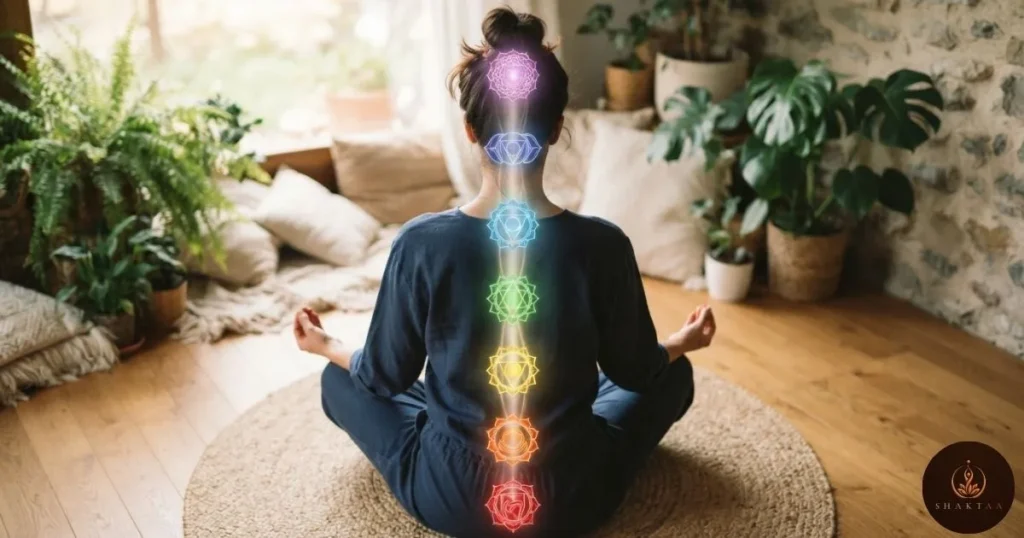
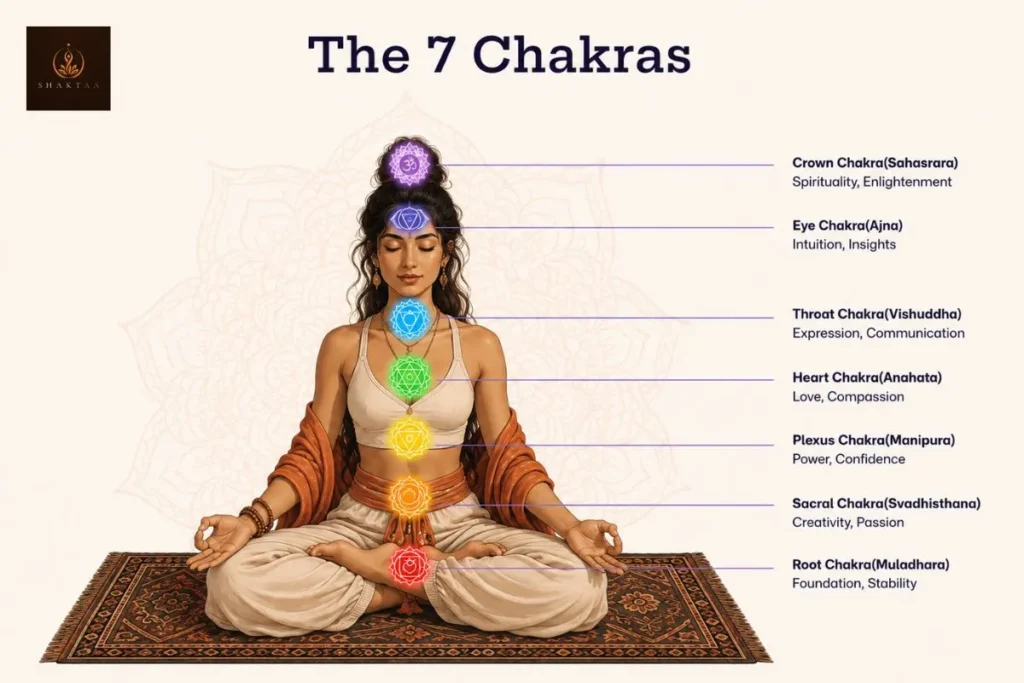
Each chakra is found at a particular location on the spine and is generally linked to a color, element, and area of emotion and physicality. Let us take a look at the chart below.
1. Root Chakra (Muladhara)
Location: Base of the spine, pelvic floor Element: Earth | Color: Red
Your root chakra is the one that controls how you feel about your safety, stability, and belonging, which relates to your connection with the basics like your home, food, money, and stability. If you feel stable here, you are well-grounded within yourself. However, if there is any instability here, it usually manifests itself through anxiety, restlessness, and worrying about survival.
2. Sacral Chakra (Svadhisthana)
Location: Lower abdomen, just below the navel Element: Water | Color: Orange
This is the center of creativity, pleasure, sensuality, and flow of emotions. This chakra is responsible for how you feel about changes, intimacy, and expressing yourself through joy. Many women report an imbalance in their sacral chakra as feeling emotionally stuck in terms of creativity, pleasure, or intimacy.
3. Solar Plexus Chakra (Manipura)
Location: Upper abdomen, below the ribcage Element: Fire | Color: Yellow
Manipura is your center of personal empowerment and willpower. It is the “fire in the belly” that gives you the ability to set healthy boundaries and take action on your behalf. In an under-active state, it can manifest itself as low self-esteem or the need to please others. An over-active Manipura manifests as controlling or perfectionistic behavior.
4. Heart Chakra (Anahata)
Location: Center of the chest Element: Air | Color: Green
The heart chakra acts as the link between the lower chakras and the higher chakras. The heart chakra is associated with love, compassion, forgiveness, and connection to other people and oneself. Women who tend to give everything to everyone else always have an imbalance in their heart chakra and may not be aware of that fact.
5. Throat Chakra (Vishuddha)
Location: Throat Element: Ether/Space | Color: Blue
This chakra controls communication — the truth of speaking your mind and listening with an open heart. The closed throat chakra is represented by swallowing your own thoughts, having problems with saying no, and constantly over-explaining yourself. When open, you experience truthful and natural communication.
6. Third Eye Chakra (Ajna)
Location: Between the eyebrows Element: Light | Color: Indigo
Ajna controls intuition, clarity, and inner wisdom, which is the capacity to think beyond superficial thoughts. Overthinking, a cloudy mind, and being disconnected from your own intuitive thoughts are some of the conditions associated with Ajna imbalance.
7. Crown Chakra (Sahasrara)
Location: Top of the head Element: Consciousness | Color: Violet/White
The crown chakra is one that symbolizes connecting to something greater than oneself – purpose, meaning, spirituality. This is seen as the ultimate of the other six chakras, which means that the crown chakra comes naturally once the other six are fairly balanced.
Yoga and Chakra Balancing: How the Practice Actually Works
This is where most beginner manuals fall short – they describe what chakras are but fail to show how a practitioner works with them. The connection between yoga and chakra balancing lies in the fact that traditionally each chakra has been associated with a particular set of poses, breathing techniques, and sounds that affect it.
A basic chakra balancing yoga sequence typically moves from the ground up:
- Root: Grounding standing poses like Tadasana (Mountain Pose) and Malasana (Garland Pose) — anything that presses the feet or hips into the earth.
- Sacral: Hip-opening poses like Baddha Konasana (Bound Angle) and gentle flowing movements through the pelvis.
- Solar Plexus: Core-activating poses like Boat Pose (Navasana) and twists that build internal fire.
- Heart: Backbends and chest openers like Camel Pose (Ustrasana) or a supported Bridge Pose.
- Throat: Fish Pose (Matsyasana) and gentle neck stretches, often paired with chanting.
- Third Eye: Child’s Pose (Balasana) with the forehead grounded, and seated forward folds.
- Crown: Seated meditation, often finishing in stillness with the crown of the head lifted long.
This is why the correct teaching of chakra flow is always organized and not random – the energy flows from the base up to the crown and ends with breathwork or meditation. The sequence of chakra flow is what we apply in our own Himalayan yoga classes at Shaktaa.
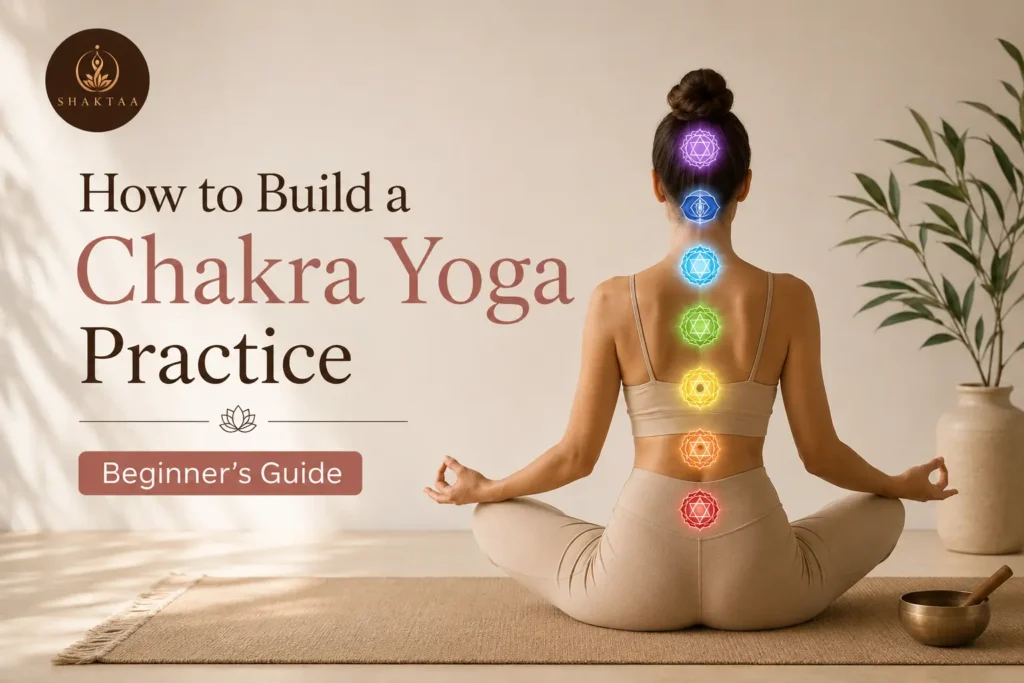
Once you understand the basic chakra sequence, you can begin turning these individual poses and practices into a more consistent routine. A chakra yoga practice for beginners does not need to be complicated; it can combine mindful movement, breathwork, meditation, and stillness in a simple structure. If you want to explore how to create a practice step by step, read our guide on how to build a chakra yoga practice.
But sound is also applied during the session of working with chakras. According to the ancient tradition, each chakra is associated with a bija mantra – LAM for the first one, VAM for the second, RAM for the third one, YAM for the fourth, HAM for the fifth, OM for the sixth, and silence for the seventh. That is why sound therapy is so popular in the Himalayan tradition, along with chakras. Tibetan and crystal singing bowls have the vibrations of the same frequencies, and the vibration of the bowl is felt, not heard. If you do not experience this combination of sound and chakra practice, you will be able to try it during our sound healing sessions at Shaktaa.
Signs a Chakra May Be Out of Balance
No exact diagnosis is required here — not every mood needs to be diagnosed. However, some moods are usually associated with certain chakras:
- Constant lack of energy or feeling of being “unsafe” even in a peaceful environment → root
- Lack of inspiration, emotional numbness, or discomfort with intimacy → sacral
- Constant self-doubts or inability to set boundaries → solar plexus
- Feelings of loneliness in spite of the surrounding people → heart
- Unwillingness to have difficult talks, or interrupting people while they talk → throat
- Overthinking, indecision, inability to follow one’s intuition → third eye
- Lack of connection to something bigger or higher → crown
If you find anything relevant here, it means just that — information which can help in your practice. If you experience any physical symptoms (digestive problems, chronic pains, sleep disturbances), it would be good to consult with a doctor, along with any other practice.
Chakra Oils: An Aromatherapy Layer Most Guides Leave Out
Essential oils have been traditionally used along with yoga and meditation in Himalayan and Ayurvedic traditions as an aid, rather than a remedy, that facilitates the process of focusing the mind on a particular intention. Traditional chakra-scent associations are as follows:
- Root chakra: grounding, earthy scents like vetiver, sandalwood, or patchouli
- Sacral chakra: warm, sensual scents like sweet orange or ylang-ylang
- Solar Plexus chakra: bright, energizing scents like lemon or ginger
- Heart chakra: soft, floral scents like rose or geranium
- Throat chakra: clarifying scents like eucalyptus or peppermint
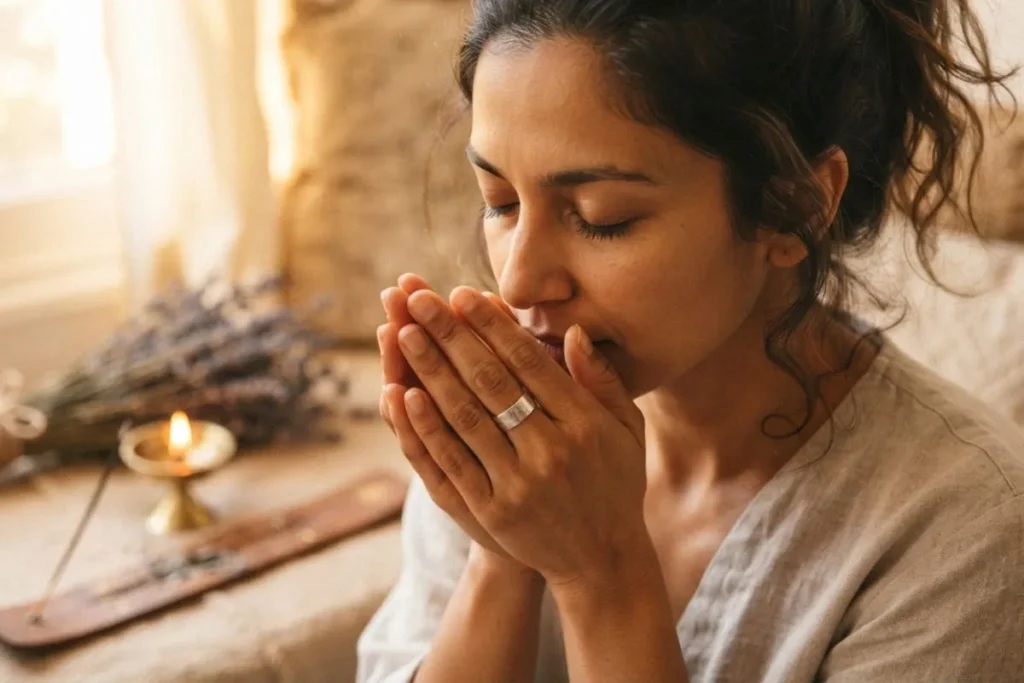
- Third Eye chakra: calming scents like lavender or frankincense
- Crown chakra: uplifting scents like frankincense or lotus
Simple beginner practice: apply a particular chakra blend to pulse points prior to your yoga or meditation practice, take three breaths through the scent and set up a one-line intention related to the chakra before starting the practice. Our chakra balancing oil collections is designed specifically for such practice – small batch blends inspired by Himalayan botanicals to use in conjunction with breath and movement practices.
A Simple 15-Minute Chakra Balancing Practice for Beginners
It doesn’t require an hour or a studio space. Here is a grounded and accessible practice for you:
- Sitting comfortably (2 minutes) — Closing your eyes, taking five deep breaths, applying the grounding oil to your wrists if you have chosen it.
- Root to sacral (4 minutes) — Moving from Mountain Pose into a couple of slow Garland Pose squats and feeling the connection of feet and hips with the Earth.
- Solar plexus to heart (4 minutes) — Easy seated twist, then moving to a supported Bridge Pose or any easy back bend.
- Throat to third eye (3 minutes) — Fish Pose or easy neck stretch, and then folding forward into Child’s Pose, resting the forehead on the floor.
- Crown — stillness (2 minutes) — Sitting upright with the spine straight and just breathing. No specific goal. No mantra is necessary unless it feels natural to you.
Here, consistency is more important than time spent. Five minutes a day with your focus will help you more than one hour per month.
Why the Himalayan Approach Is Different
Most of the chakra content today has become very superficial, reduced to shopping lists of crystals and infographics on Instagram. What is missed out on here is the lineage of knowledge that has been passed down by generations of teachers in the Himalayas, that of how chakra practice is never separate from breathing techniques, ethics, and community.
At Shaktaa, the approach to chakra balancing is based on this much larger lineage. Chakras are not a trend but a living part of Vedic feminine wellness that requires slow and deliberate practice, preferably guided. If this has spoken to you, then our women’s retreats in rishikesh are designed for women who wish to move past reading about chakras and actually practice them in the mountains, for an entire week.
Getting Started: What We’d Tell a Friend
When you’re just getting started, don’t try to “balance” all seven chakras at once. Just pick whichever one seems the most applicable for what you’re experiencing at the moment – most women usually know which it is intuitively. Work on that single center for two or three weeks, using some postures, breathing technique, and perhaps an aromatherapy ritual before you move on. It takes time and is much more effective when practiced patiently.
Chakra yoga is not about achieving the perfect position or reciting seven words in Sanskrit. It is a systemized and ancient way of posing a simple question to yourself, one aspect of your being at a time: Where am I tensed up, and how can I relax?
Frequently Asked Questions
1. What is chakra balancing yoga, and how is it different from regular yoga?
It is a method wherein the postures and breathing techniques are done according to the seven chakras, starting from the base of the spine going upwards.
2. How do I know which chakra is blocked?
There is no clinical test for this since usually, people discover their blockage through recurring issues such as anxiety and lack of confidence and then relate it to the chakra that is associated with it.
3. Can chakra balancing help with anxiety and stress?
Since it involves breathing techniques and body movements, it may help calm down your nervous system although there is no clinical proof that this happens specifically because of the chakra balancing.
4. How often should I practice chakra balancing yoga as a beginner?
Better to practice regularly for 10 to 15 minutes per day 4 to 5 days per week rather than infrequently for long periods of time. Spend a couple of weeks for each chakra.
5. Do I need special tools like crystals or oils to start chakra balancing?
No-breath and movement are sufficient to start. Chakra oils and singing bowls are not necessary; however, some people find that they assist in grounding the mind and lend a sense of ritual and routine to the process.