Yes – Rishikesh is considered one of the safest places in India for solo women travel due to its small size, restrictions on the presence of alcoholic beverages, a big international community of wellness enthusiasts, and the town’s culture focused on yoga and meditation practices rather than nightlife. However, safety in this case implies taking all the necessary precautions, which are the same in any other unfamiliar destination: choosing trusted accommodation, traveling by day, being careful with the use of spiritual language in building fast relationships, and relying on your intuition rather than an engaging conversation. Most of the women who have been there felt safer there than in the major Indian cities, and the paragraphs below will explain how to make your trip safe.
This is the reason why so many women continue to choose Rishikesh as their first solo destination in India. Women solo travel in Rishikesh started out as a niche practice among yoga students and turned into a kind of rite of passage – a place where women come to when they need a break from their usual life and find inner peace.
Why Women Are Drawn to Rishikesh in the First Place
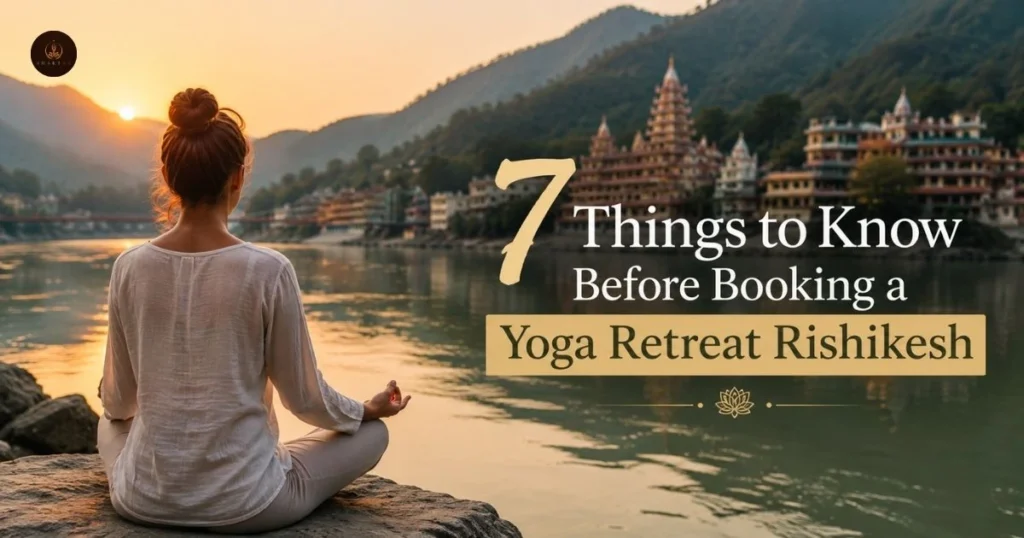
Rishikesh is the place where the Ganges comes out of the foothills of the Himalayas and into the plains, both geographically and emotionally speaking, a transition point. The women come to Rishikesh in the middle of transitions: after a breakup, after burnout, after their birthdays, after a loss, or even just during a period in their lives when everything has become too much.
It does not hurt that Rishikesh’s economy and identity are entirely dependent on inward-looking activities — yoga, meditation, Ayurveda, satsang, kirtan — and not parties or shopping. This gives the place a certain atmosphere that other Indian cities cannot compete with. It is not unusual to be sitting by the river quietly for an hour; that is just Tuesday.
Is Rishikesh Actually Safe for Solo Women? A Grounded Answer
Most of the guides just give you an absolute “yes” in response to that question and let it go at that. But we’d prefer to give you something that will be more helpful to you — safety in Rishikesh has multiple dimensions, and it’s worth considering each one individually.
Physical safety
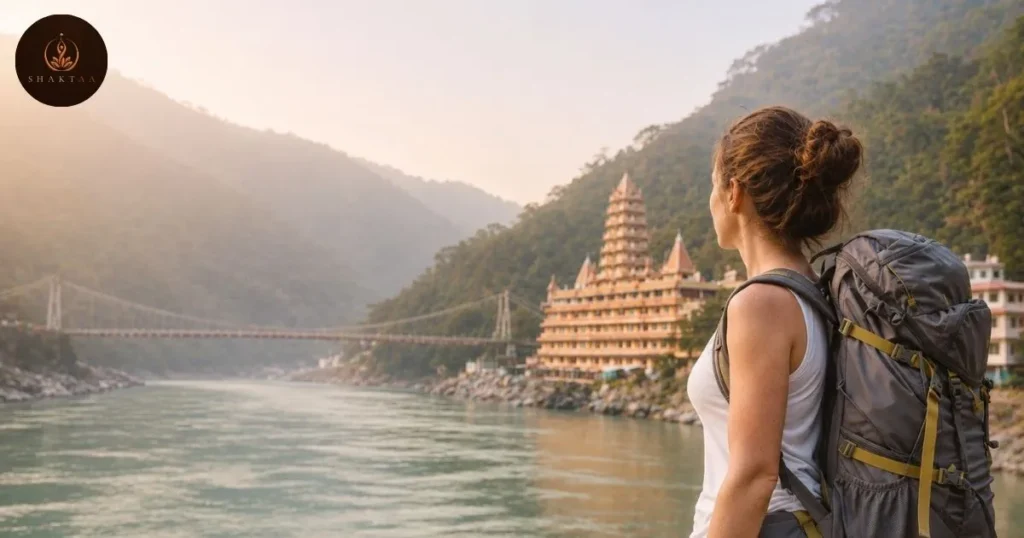
Rishikesh is considered one of the safer cities for women traveling alone in India mainly due to its size and function. It is relatively small, walkable, alcohol consumption is prohibited in most of the city, and the influx of foreigners means that the local population is used to seeing women travel on their own in tourist zones. However, “generally safe” does not mean “without risks,” and it is precisely this misconception that leads to problems. The same precautions one needs to take when traveling to any new city – being aware of the surroundings, walking along well-lit streets at night, and not giving away information about accommodation to strangers – apply here as well.
Cultural safety
Rishikesh is a pilgrimage city first, and a tourist city second; the two aspects do not always go hand in hand. You will find some respect for the sacred, as well as some touts and self-declared “gurus” who have perfected the art of what to say to the women seeking spiritual enlightenment. Being warm and approachable is something that you expected when coming here; you don’t have to put your guard up all the time. However, it should be noted that spiritual talk (“Come, I will teach you how to meditate,” “You have an old soul energy”) can also serve the purpose of a pickup line.
Emotional safety
Women Solo travel in Rishikesh allows for an expansion of space. The grief, past memories, and unaddressed emotions that have built up are likely to come up once you have that space to address them. This may very well be the whole purpose of your travel in the first place, though it can be destabilizing if you don’t know what’s coming. You must have a place that can accommodate such an experience.
Where to Stay: Tapovan, Laxman Jhula, and Ram Jhula Compared
Everyone will tell you these three areas are “safe and popular.” Here’s what actually differentiates them, because it changes your whole experience.
Tapovan:Located slightly above the river level on the western bank, this area is home to the yoga schools. In the mornings, yoga classes are held on mats in guesthouse courtyards very early. At night, it is quieter and has a strong long-term foreign student community and is suitable for those women who prefer a structured daily schedule.
Laxman Jhula: More crowded and commercial place with many cafes, bookshops and markets. Suitable for those who do not mind noise and want to be surrounded by people all the time. Here evenings are more lively and safe simply because of the presence of more people.
Ram Jhula: The location of some of the bigger ashrams, such as Parmarth Niketan, which is famous for the evening Ganga Aarti ritual. This bank is more religiously-oriented. For those travelers whose aim is the participation in ceremonies and rituals, not yoga classes, Ram Jhula is the preferable option.
Regardless of your choice, always try to arrange accommodation at an ashram or guesthouse that has been reviewed by solo women travelers only. It is possible that a guesthouse or ashram may be great for couples and groups but has not considered all the requirements of a solo woman traveler, including having a locking system inside the room, and having a female employee.

Solo Trip or Women’s Retreat in Rishikesh? How to Decide
This is a question we receive all the time, and the honest truth is: it depends on what you’re seeking.
An all-out independent travel of women solo travel in Rishikesh trip is an adventure that is totally free of any time constraints and the risk of getting lost. This type of trip is ideal for women who have already traveled in India before, know how to move about freely and would like to travel without any restrictions.
A women’s retreat in Rishikesh, specifically designed for women, will provide you with a contained environment. All meals, workshops, accommodation, and logistical arrangements are done for you, and all your energy will be devoted to the process itself. This kind of trip will work better for women new to India, experiencing an especially raw emotional phase of their lives, or just women who prefer not to waste their first day in figuring out which auto-rickshaw fare is legitimate.
None of them is more or less legitimate. Many of the most transformational journeys include a combination of both – structured days at a retreat to settle in and form a support group, and unstructured independent days to integrate.
What a Yoga Retreat in Rishikesh Actually Looks Like, Day to Day
It’s worth knowing what you’re signing up for before you book, because “retreat” gets used loosely.
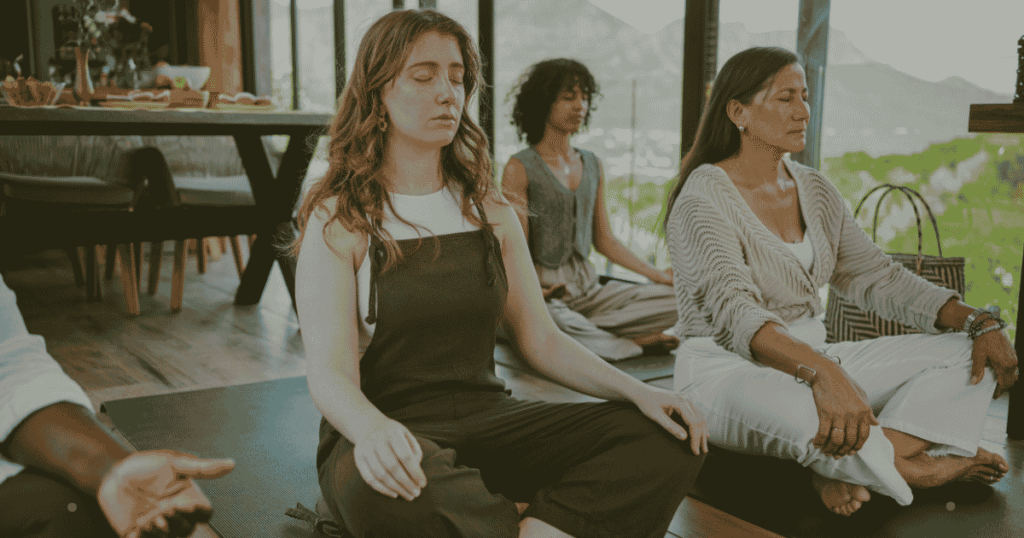
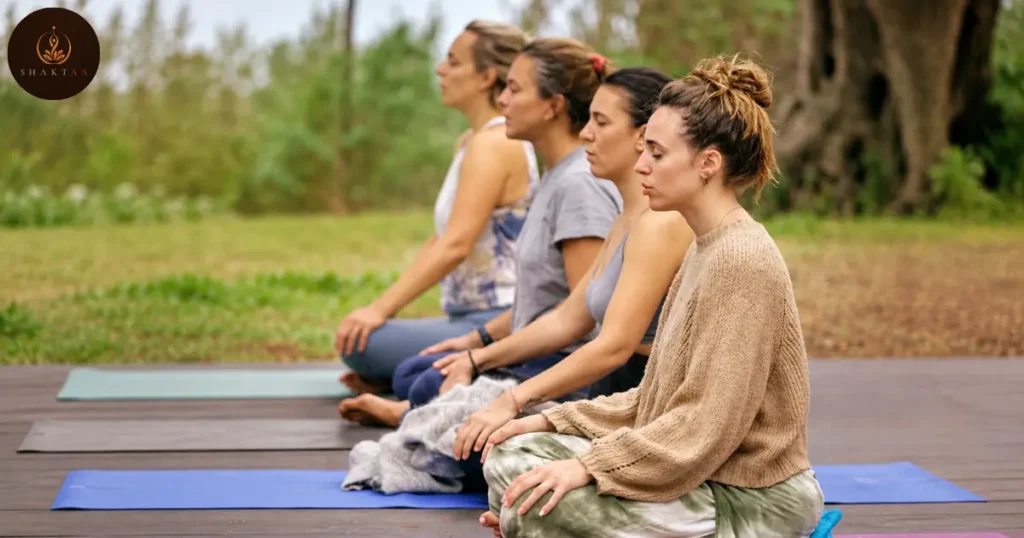
A genuine yoga retreat in Rishikesh usually follows a rhythm shaped by the day itself, not a packed activity list:
- One of the early practices, before the heat arrives — usually pranayama, followed by asana, practiced slowly rather than athletically
- A light breakfast, predominantly vegetarian, and usually sattvic (without onion, garlic, or heavy spices), helping to improve digestion and calm down the nervous system
- A quiet midday period for resting, journaling, discussing philosophy, or walking
- An afternoon or evening practice, which could include restorative yoga, meditation, or a sound healing session
- Ganga Aarti in the evening, if the timing of the retreat coincides with it — a community ceremony involving lamps, chanting, and offering to the river
- Going to bed early, usually retiring much earlier than you normally do at home
This pace may feel a bit too slow for the first couple of days. However, this is quite natural, and in fact, sometimes, this is when the real transformation happens.
Sound Healing in Rishikesh: Why It’s Become Central to Women’s Inner Work
Sound healing in Rishikesh has moved from a niche offering to something close to a signature practice here, and it’s worth understanding why it resonates so strongly with women specifically.
The sounds used in this region are based on the singing bowls of the Himalayas, gongs, tanpura drone, and mantra singing, which are practices that have been done in meditation and healing practices for years before “sound bath” was a wellness catchphrase anywhere else. The feeling of the low frequencies traveling through your body has a tendency to override the mind in a way that sitting meditation doesn’t always do for women with tension in their chest, jaws, or shoulders from always being “on.”
Here are some points to consider if you wish to have a sound healing session:
- Find out the amount of training that the practitioner has undergone and from whom. It is important since sound healing is not regulated internationally.
- Choose sessions in which the number of participants is small (from six to twelve people) instead of large public events if you want to get a truly relaxing experience.
- Come with an open mind and an intention without any desired results. Sound healing often disappoints those who expect to get something special and helps those who come to receive.
Connecting to Divine Feminine Energy Along the Ganga
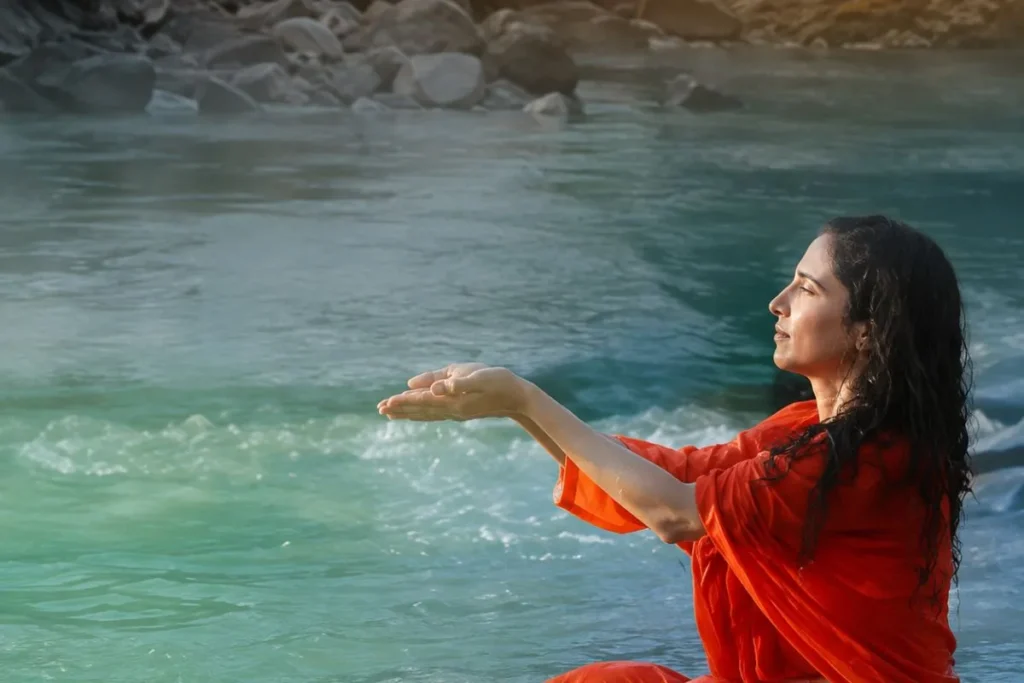
The association of Rishikesh with the divine feminine is more profound than what the popular wellness interpretation of the term implies. For instance, the river Ganga herself is venerated as Ganga Ma – the goddess and not a figure of speech – and each day’s ritual of Aarti is, in essence, an act of reverence for divine feminine energy in flowing waters.
For women, in particular, this setting holds significance in ways that it wouldn’t for a traveler in general. Rituals revolving around rhythmic flow, receptivity, and embodiment – rather than strict discipline and control – find their place here since the entire town revolves around the river that is deemed sacred and feminine.
A few ways women engage with this during their stay:
- Participating in Ganga Aarti not as a spectator ritual but as a silent personal act — lighting a diya and making an intention as it floats away
- Morning or evening sitting on the banks of the river precisely to observe the cycles of energy within yourself rather than adhering to a rigid schedule
- Looking for women’s circles or satsangs where the approach is more experiential than philosophical
This is not about substituting your personal belief system with one borrowed from elsewhere. This is about recognizing the way an entire place that is structured in accordance with a feminine divine entity alters the nature of internal work.
Practical Safety Guide: The Details That Actually Matter
- Wear clothes that cover your shoulders and knees. Modest clothing is polite, but it is also much more comfortable in the hot weather. You are not being restricted; many women feel liberated by the ease of dressing modestly in India.
- Plan your walks. The main roads that run through Tapovan, Laxman Jhula, and Ram Jhula stay busy and well-lit until late at night. The river-side roads and the forest roads will clear out quickly once it gets dark — use them during the day.
- Check your transportation. Taking prepaid taxis or cabs from the app at the airport is worth the little extra money when you arrive. In the area, most guesthouses have recommended drivers.
- Always have a physical and digital record of your accommodation, identification, and emergency contacts. Let people know what your plans are every day, loosely.
- Be aware of the national emergency number: 112. It is useful to have saved it before you arrive, along with the front desk number of your accommodation.
- Listen to your instincts in spiritual matters. True teachers are not pushy with intimacy or secrecy from other travelers. If something feels off despite the “spiritual” aspect, listen to that data point.
- Feminine hygiene products can be harder to find outside main markets, particularly certain brands or menstrual cups — bring what you know you’ll need.
What to Pack for a Solo Wellness Trip
- Lightweight and breathable clothing that covers your shoulders and knees, as well as one warmer layer for the early morning time along the river
- A shawl or scarf, which will be handy when visiting temples and in the evening, as well as in case of need for an additional layer while meditating or during sound healing
- A water bottle and some digestive medication, because it will take you several days to get used to sattvic food and water
- A journal, which is one of the most used items while traveling like this
- A torch, for those sections of the riverside path where the light goes away early
- Your regular medication and a copy of the prescription for it, if needed
Honouring Your Cycle While You Travel
It is something that very few travel guides mention, but it is really important. If your journey coincides with your menstrual period, then plan for it instead of planning around it. There is often an option to have some rest during more rigorous practices at retreats, and it is perfectly okay to pass on an intensive asana class or a long walk in favor of some restorative practices – Rishikesh is quite flexible about this when compared to any ordinary vacation itinerary. If cycle-appropriate practice is important to you, you should probably inquire about it from the retreat itself.
Questions Worth Asking Yourself Before You Go
- Do I want complete freedom, or will I be more myself if there’s a bit of structure around me?
- What is it I want to feel different when I leave — rested, clear-headed, brave, more in touch with myself?
- Can I sit in silence and my own headspace for extended periods of time, or do I need a bit of help with that?
- Is there a particular practice — yoga, sound healing, meditation, ritual — that I’m looking to explore more deeply, or do I simply want to see where things lead?
There are no right or wrong answers to any of this. However, asking these questions prior to your arrival is more likely to lead to a much more fulfilling journey than discovering them when you arrive.
Frequently Asked Questions
Is Rishikesh safe for a woman travelling completely alone?
Yes – women solo travel in Rishikesh is widely considered safe, with the same sensible precautions you’d take anywhere new: daylight travel between towns, safe transport and accommodation, and awareness of how spiritual language can be used to build quick trust. Many women report feeling safer here than in India’s big cities.
How many days do I need for a meaningful trip?
A period of four to five days will be adequate for settling into and deriving the benefit of the retreat framework. Ten days to a week provides the opportunity for combining structured learning with unstructured individual time.
Do I need prior yoga experience to join a retreat?
No. Retreats in Rishikesh are designed for all experience levels, and the trainers usually provide modifications. It is more important to be ready to go slower.
Is it normal to feel emotional during a solo trip here?
Of course, it is so frequent that any retreat leader who has experience would not be surprised at all. Taking away your normal environment and introducing silence will bring up many things that are normally suppressed by the hustle of your daily life.
What’s the best time of year to visit?
Generally, from September to April is the time when you can expect good weather and all ashrams and retreat centers functioning fully. However, monsoon season (from June to August) is relatively peaceful and green but not suitable for river-related activities and some treks.
Before You Arrive
Rishikesh doesn’t need you to be fearless to visit on your own — what it needs from you is to be prepared, aware and truthful about why you are coming here. Whether you come here to join a women’s retreat or come here as an independent traveler, Rishikesh is definitely an open space for such trips.
We at Shaktaa work with women before, during and after exactly these kinds of trips. This guide is not a list of tips on how to travel safely borrowed from some travel forums. This guide contains the information which we would give to a woman who contacts us one week before her trip to Rishikesh — not only the safety tips, but also the things which are not mentioned in headlines: how to choose the place to stay, what does the retreat give you that the independent trip can’t give you, and how to use the spiritual practices of the town which you wouldn’t expect from it.
If you are hesitating between an independent trip and a retreat, or you want to discuss what spiritual practice — yoga, sound healing or meditation — would be appropriate for you at this point, Shaktaa will be happy to help you.