

Table of Contents
Along the banks of the Ganga, with the Himalayan foothills rising around it, Rishikesh has always been a place where sound and silence meet. The sounds of temple bells, the rhythm of chanting, the silence of meditation and breath-led practices of yoga are woven seamlessly into daily life. Between these sounds are moments of stillness, periods of silence that invite you to turn inward.
For someone exploring wellness in Rishikesh, sound healing offers a different way to slow down not by forcing the mind to become quiet, but by giving attention to something gentle to listen to. Sound healing in Rishikesh brings this idea into a guided wellness experience, using instruments such as Himalayan singing bowls and other resonant sounds to encourage relaxation, mindful awareness, and a deeper sense of inner connection.
What Is Sound Healing?
Sound healing is an age-old wellness method that combines sound, vibration and resonant frequencies to create a setting for relaxation and conscious awareness. Singing bowls, gongs and chimes are instruments that provide prolonged sounds that inspire you to slow down and listen to the sounds you hear. The shifting layers of sound might give a soothing focus of attention during a session, rather than trying to drive the mind into silence.
Other instruments might add softer or deeper sounds. Other ways are also investigating how sustained tones may allow for a more relaxed, contemplative state. This is one of the reasons why sound healing India has grown more and more associated with meditation, relaxation and holistic wellness. Experiences differ from person to person but the aim is frequently to establish a peaceful area for rest, reflection and mental well-being.
Why Rishikesh is a Great Place for Sound Healing
In the natural surroundings of Rishikesh, sound and meditation traditions naturally come together. Sitting on the banks of the Ganga at the foothills of the Himalayas, the city has long drawn those looking for yoga, meditation, chanting and an escape from the rigors of daily life. The sounds of running water, temple bells, mantras and silence might become part of the experience itself. If you’re looking for sound therapy in Rishikesh, this setting can make the practice feel less disconnected from its environment and more in tune with the pulse of the place.
The link is deeper than the landscape too. Indian traditions have a long history of contemplative practices that involve holy music, mantra, breath and meditation. Modern Himalayan sound healing incorporates elements such as singing bowls and other resonant instruments into contemporary wellness experiences. At Shaktaa, the link between sound, quiet, meditation and women’s wellness is behind the thought of Pranaum, its evolving sound-healing pathway.
Understanding Himalayan Singing Bowls
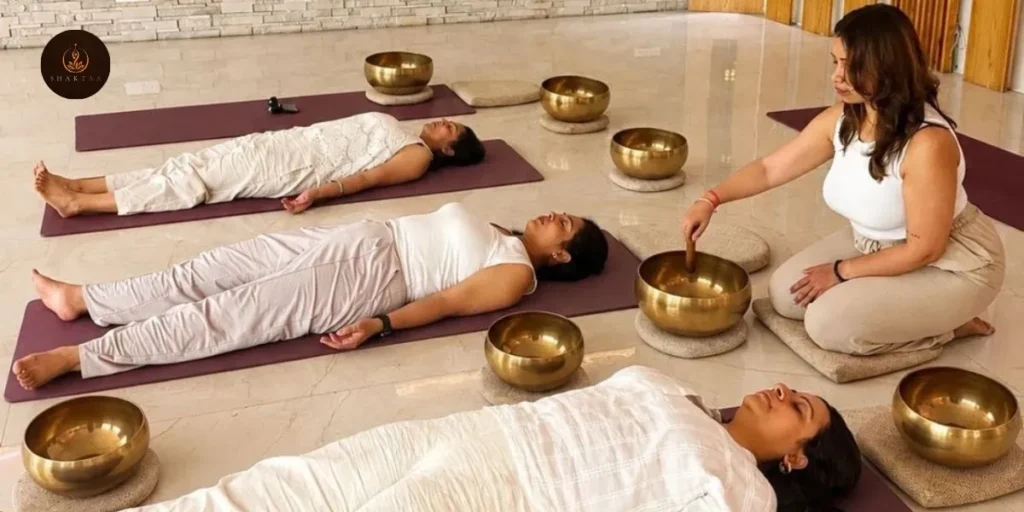
Himalayan singing bowls are metal, hand-cast instruments famed for their deep, resonant sounds and long-lasting vibrations. They have long been linked to meditation and contemplative activities in Himalayan and South Asian traditions. Today, they are also employed in sound-based wellness treatments, where their tones can serve as a quiet focus for relaxation and attentive listening.
Origin and Traditional Use
- Himalayan heritage: Although the actual historical origins of singing bowls are hard to locate to a single spot, they are connected to places like Tibet, Nepal, Bhutan, and India.
- Traditional craftsmanship: The bowls are created from metal alloys, and their sound is related to their shape, thickness, size and craftsmanship.
- Meditation and ritual: Bowls like these have historically been used with meditation, prayer, ritual and other contemplative practices.
- Modern health : Their long, resonant tones have made them popular in today’s meditation and sound-based wellness sessions.
How do the Himalayan Singing Bowls make sound?
- Striking: A mallet tap on the bowl produces an immediate clear tone that slowly dissipates.
- Rimming: Rimming the mallet around the outside rim can create a continuous, sustained reverberation.
- Various sizes of bowls: Larger and smaller bowls can produce distinct tonal qualities, enabling practitioners to make layers of sound.
- Vibration and resonance: The metal’s physical vibration creates the characteristic sound that participants listen to during meditation or sound healing.
Why Do We Use Himalayan Sound Bowls for Healing?
- A focus for attention: The steady tone might provide the mind something simple to listen to when in a meditation or relaxation practice.
- Encourages stillness: Tracing a sound from start to its slow fade-out might assist set a slower, calmer rhythm.
- Supports meditation: Singing bowls are commonly used in singing bowl meditation to add focused listening to the exercise.
- Creates a sensory experience: Sound healing is a sensory experience, as the session involves the use of sound, vibration, silence and aware breathing.
- Individual experience: People experience diverse reactions to the same sounds, thus it’s better regarded as a wellness and meditation practice than a guaranteed treatment.
What Happens During a Sound Healing Session in Rishikesh?
A sound healing session in Rishikesh is usually a guided experience designed to help you slow down, listen, and settle into a quieter state. You may be seated comfortably or lying on a mat while a practitioner works with instruments such as Himalayan singing bowls, crystal bowls, bells, chimes, or other resonant instruments. The experience is usually gentle and does not require you to know how to meditate or play an instrument.
How Does a Sound Healing Session Begin?
- Arrive and settle in: Take a few minutes to leave behind the pace of the day and get comfortable in the area.
- Get comfortable: Depending on the session you may sit or lie down on a mat with cushions or a blanket for support.
- Start with awareness: You may be taken through some simple breathing, grounding or a calm intention before the noises begin.
- Let go of expectations: No special experience is required to get there. The exercise is just an invitation to listen, to breathe, to be present.
What goes on throughout the sound experience?
- Himalayan singing bowls: The practitioner may gently strike or play the bowls around the space, producing continuous resonance tones.
- Combination of sounds: Crystal bowls, bells, chimes, gongs or voice might be added depending on the style of the session.
- Focused listening: Instead of actively engaging in a practice, you can just let your attention rest on the shifting tones and vibrations.
- Breath and stillness : Once the noises have started, you may notice that you are automatically becoming more conscious of your breathing and the feeling of quiet.
- Moments of silence: The gaps between sounds are also part of the experience. They give you time to notice how you feel without racing to the next action.
What Might You Experience Afterwards?
Everyone responds to sound differently. You may feel relaxed, quiet, reflective, sleepy, refreshed, or simply more aware of your surroundings. Some people may also notice that they have become more conscious of emotions or thoughts that were easy to overlook during a busy day.
The important thing is not to expect a particular result. A sound healing session can offer time and space for relaxation, mindful awareness, and personal reflection, with the experience varying from one person to another.
What to Wear to a Sound Healing Session?

There’s no special outfit to wear for sound healing. Since you may be sitting or lying down for much of the session, comfort is the key consideration.
Choose Comfortable clothes
- Use soft, breathable fabrics: Comfortable cotton or casual attire will help you get comfortable for the session.
- Avoid restrictive clothing: Tight waistbands, stiff textiles, belts, or anything that presses against your body may become uncomfortable while lying down.
- Bring a light layer: A shawl, sweater or light jacket can come in handy, especially if you are sitting motionless for a long amount of time.
- Keep accessories minimal: Loud jewelry, watches or other accessories might be a distraction during a quiet sound session.
- Choose comfort over appearance: You are there to relax, so clothes that help you feel at peace are more useful than something fancy.
Who Should Be Careful Before Sound Healing?
While sound healing is widely considered a complimentary wellness and relaxation technique, it may not be comfortable or acceptable for everyone in all formats. All of these can matter—the loudness of the sound, the instruments utilized, the volume, and whether instruments are placed directly on or near the body.
People Who Might Need Extra Caution
- People with implanted medical devices: If a session contains powerful or direct vibrations, especially with instruments put on the body, it is advisable to seek advice from a healthcare professional before the session.
- People with seizure disorders: Certain repetitive sounds or sensory stimulation may be problematic for some persons, thus it is necessary to obtain proper medical guidance.
- People with tinnitus or sound sensitivity: If you are sensitive to loud or certain frequencies, tell the practitioner beforehand so the experience can be approached correctly.
- People recovering from surgery or with physical conditions: At various stages of rehabilitation it may not be appropriate to vibrate directly or stay in one position.
- During pregnancy: If you are pregnant, especially if you are using equipment that touches the body directly or stronger vibrations, please visit your healthcare professional and inform the practitioner before participation.
What Are the Benefits of Sound Healing?
People come to sound therapy for many reasons and the experience can be very different for each individual. Rather than offering a promise of a certain physical or medical result, it can be better to think of the practice as an opportunity to slow down, listen attentively and allow room for relaxation and introspection.
Potential Benefits of Sound Healing
- Deep relaxation: Long, resonant tones may help to establish a relaxing environment where you can escape the usual stimuli.
- A focus for meditation: The sound of a singing bowl can offer your focus a basic point to return to, which may be helpful for persons who find silent meditation challenging.
- Mindfulness awareness: You can encourage yourself to stay engaged with the present by listening carefully to a tone as it begins, changes and fades.
- A sense of mental quiet: Spending undisturbed time in a still place may help you briefly step away from a bustling stream of ideas.
- Emotional reflection: In the quiet moments in or after a session we might become aware of our thoughts and feelings without instantly acting on them.
- A feeling of renewal: Some people leave a session feeling rested, lighter, or renewed, while others may simply appreciate having taken time for themselves.
If you have a medical condition, major sound sensitivity, or any question about whether a session is suited for you, seek expert medical counsel first. Sound healing is a complement to competent medical therapy, not a substitute.
Sound Healing for Women: Creating Space for Rest & Reconnection
It is difficult for many women to find time for undisturbed relaxation. A sound healing session is a space for just being – there is nothing to strive or perform – you may just slow down, listen, breathe and be present. The use of instruments such as the Himalayan singing bowls can facilitate the experience to combine sound, quiet, meditation and attentive awareness in a calm environment.
Why is sound healing important for women?
- Making space for rest: Taking time away from the daily grind might provide you with a much needed opportunity to pause and reconnect with yourself.
- Inner awareness development: Sustained sounds can help you to notice your breathing, thoughts and emotions without having to respond to them straight away.
- A space for reflection: Silence before, during, and after a session can allow space for personal introspection and emotional awareness.
- Connection and community: Sharing sound with other women may create a feeling of shared presence, especially when the space is purposely designed to feel supportive and safe.
- Reconnecting with yourself: For some women, the blend of sound, quiet and meditation is an easy approach to step out of a bustling routine and shift attention inward.
This woman-centred approach combines organically at Shaktaa with Pranaum, the new sound-healing pathway bringing together Himalayan sound, meditation and contemplative practices. The focus is on establishing a safe space for women to stop, listen and create room for their own wellbeing.
Frequently Asked Questions
What is sound healing in Rishikesh?
Sound healing in Rishikesh is a guided wellness method that uses resonant sounds and instruments such as Himalayan singing bowls, bells, gongs or crystal bowls to enhance relaxation and attentive awareness. Sessions can also feature breathing, meditation and periods of stillness.
How do Himalayan singing bowls function in sound therapy?
Himalayan singing bowls emit long tones when struck or played around its rim. During a session, these resonant sounds can be a primary focus for listening and meditation, allowing participants to slow down and become more peaceful.
What is singing bowl meditation?
Singing bowl meditation uses the sustained tones of singing bowls as an object of attention. Instead of focussing on the silence you might follow the sound as it begins, resonates and slowly disappears. It’s suitable for beginners as well as those with an established meditation practice.
What are the benefits of sound healing?
People attend for the benefits of sound healing such as relaxation, attentive awareness, a sensation of mental stillness and space for reflection. Because everyone’s experience is unique, sound healing should be considered a complimentary health practice and not a cure for a medical issue.